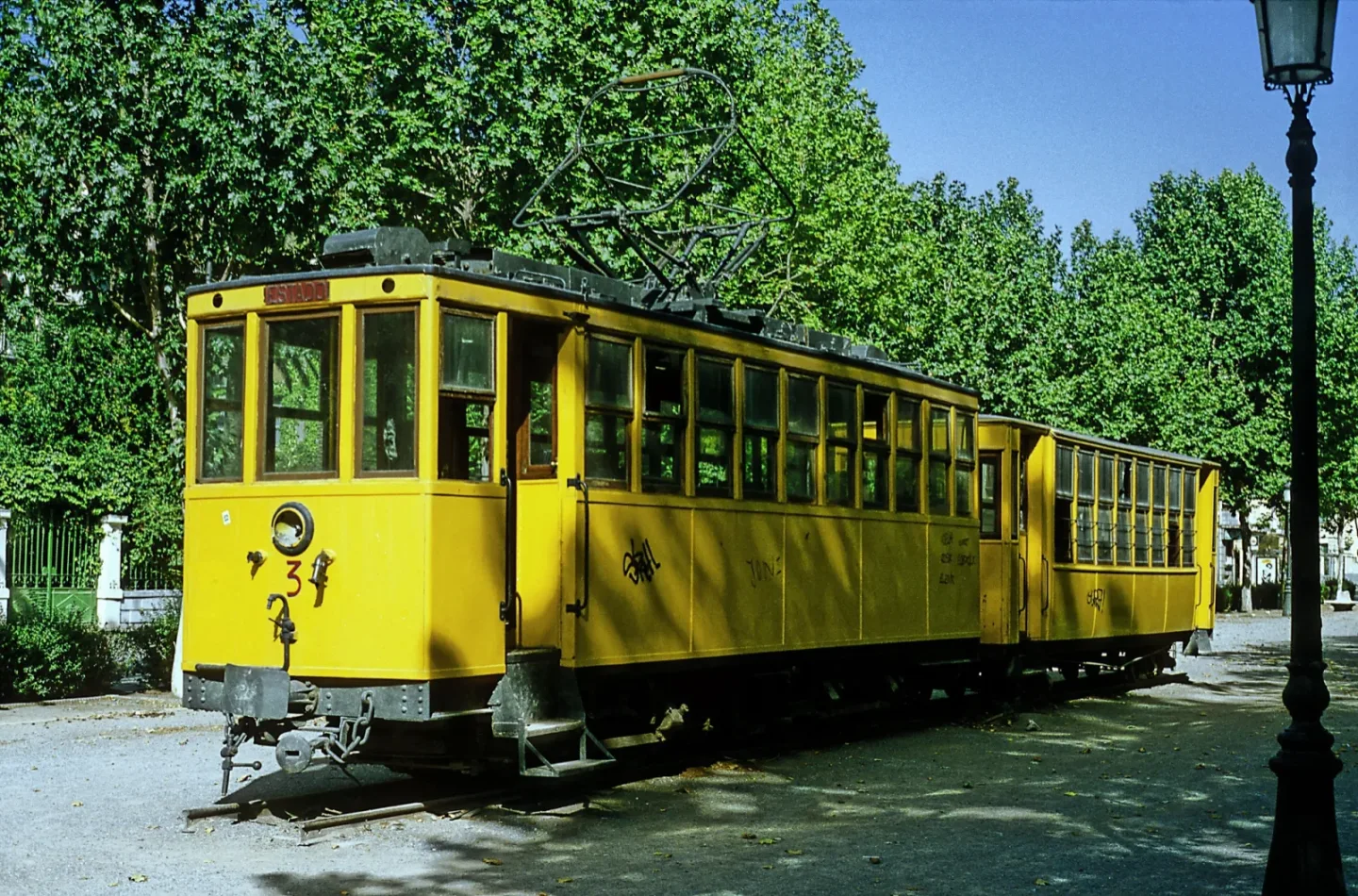
For nearly half a century, a narrow-gauge electric tram climbed the Genil valley from Granada to Güéjar Sierra, Maitena and the Barranco de San Juan. It closed in January 1974 and part of its route is today a greenway.
GranadaYa newsroom
·
Photo: Falk2 / Wikimedia Commons (CC BY 3.0)
Between 1925 and 1974 an electric tram left Granada and went up the Genil valley towards Sierra Nevada. It reached Güéjar Sierra, Maitena and, later, the Barranco de San Juan. In Granada it was called the Sierra tram. Part of its route is today under the Canales reservoir or under the road; another part can be walked.
A hotel in the sierra
The idea of going up to the sierra on rails is older. In 1906 a project by the engineer Strub for a 35-kilometre line to the Mulhacén was presented in Granada, which was not carried out, according to the Güéjar Sierra tourism website and the study published on agraft.es.
The project that went ahead was that of Julio Quesada Cañaveral, duke of San Pedro de Galatino. The company Tranvía-Ferrocarril de Granada a Sierra Nevada was founded on November 5, 1919, with him as president. According to the English Wikipedia, the duke, who had factories, hotels and a hydroelectric plant, wanted to link the city with a hotel in the Maitena valley. From the Maitena station, travellers went up to the Hotel del Duque in horse-drawn carriages.
Work began in early 1921. On February 21, 1925, at half past ten in the morning, the first section, from Granada to Canales, 12.2 kilometres long, was opened. In June of that year the trams already reached the Güéjar Sierra station provisionally, and in 1928 Maitena. The extension to the Barranco de San Juan, with an intermediate station at El Charcón, was built between 1944 and 1947, according to local sources; the English Wikipedia dates it to 1956.
Tunnels, bridges and losses
It was a narrow-gauge line, of 0.75 metres, electrified at 1,200 volts of direct current. The full route was more than 20 kilometres, with a difference in level of about 470 metres. To make its way through the valley 15 tunnels were dug and 21 bridges were built, according to agraft.es; the Güéjar Sierra tourism website speaks of 14 tunnels. One of those bridges, the Blanquillo bridge, is among the first reinforced concrete works in Spain, according to the same source.
The initial budget was 1.2 million pesetas and the work cost 4.25 million. The line never made a profit and was sustained with the income from other businesses of the duke, according to the English Wikipedia. After a staff strike in June 1931, the State took over the operation in July; the service resumed on August 3.
There were plans to go higher. In 1942 the engineer José Pérez Pozuelo planned to extend the line to La Estrella and a cable car up to about 2,500 metres of altitude. The Cortes approved it on December 11, 1951, but it was never built.
The reservoir and the greenway
The end came with the Canales reservoir, which was going to flood more than five kilometres of the route. The Council of Ministers agreed the closure on December 7, 1973 and the last journey was made on January 19, 1974, according to agraft.es and the Güéjar Sierra tourism website. The English Wikipedia gives January 20.
The tracks and the overhead line were dismantled, and part of the material was sold as scrap. The railcar number 3 and trailer 15 were put on display in the Paseo del Salón in Granada; the trailer suffered a fire in 1993. Known sections of the line, such as the Poyos Canaleros and the Cueva del Diablo, were left under the water of the reservoir, and part of the trackbed was used to widen the Sierra road.
What survives is upstream of the reservoir. The old route is today a path and, according to the Güéjar Sierra tourism website, one of the two greenway routes in Granada, enabled for accessible hiking. From Maitena, a path reaches the Barranco de San Juan, where the last station was. The stations are still standing, though abandoned, according to agraft.es.
Anyone wanting to know what the weather will be like in Granada these days will find the updated forecast on our weather page.
Share this story
Breaking news from News, on your phone
An alert only when something can't wait. Free, no account needed.
On iPhone, alerts only arrive if you first add GranadaYa to your Home Screen.
How to do it, step by step
This browser can't receive alerts. Try another one, such as Chrome or Safari.
You've blocked alerts from GranadaYa in this browser. You can turn them back on in its settings.
How to do it, step by step