29-N general election in Granada How to vote, the calendar and every result since 1977

Time-restricted fasting does not reduce liver fat more than the Mediterranean diet

Topics Hospital Universitario Virgen de las Nieves ibs.GRANADA University of Granada

A trial with 197 participants from Granada and Navarra concludes that losing at least 5% of weight is what really reduces liver fat.

GranadaYa newsroom ·
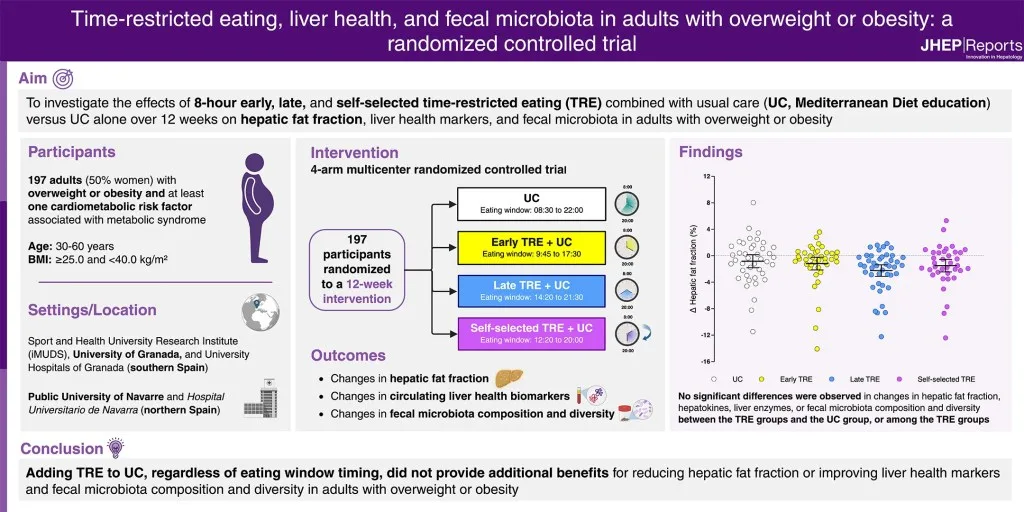
Póster científico sobre un ensayo clínico que compara ayuno restringido y dieta mediterránea con gráficos y diagramas de participantes.
Photo: Universidad de Granada
Losing weight is what reduces liver fat, not the time of day when you eat. A clinical trial with 197 participants aged between 30 and 60 with overweight or obesity, led by the University of Granada (UGR) and the Public University of Navarra, has compared three forms of intermittent fasting with a nutritional education programme based on the Mediterranean diet. None of the three eating windows added benefits for liver fat compared with usual care. The study, published in the journal JHEP Reports, randomly assigned participants to four groups: standard care, early fasting (approximately between 9 and 17 hours), late fasting (between 14 and 22 hours) and free-schedule fasting, on average between 12:20 and 20 hours. For 12 weeks, all followed the same nutritional education and healthy habits programme. Liver fat was measured with magnetic resonance imaging.

The key is the weight lost

Liver fat decreased in the three groups that practised fasting, but when compared with the usual care group the differences were not statistically significant. Nor were there differences between fasting in the morning, in the afternoon or at a freely chosen time, nor in other liver health indicators or in the composition of the gut microbiota. The greatest reductions occurred among those who lost at least 5% of their body weight, most of them in the intermittent fasting groups, and among those who already had hepatic steatosis at the start. Around 40% and 45% of those who fasted lost that 5% of weight, and reaching that threshold was associated with a notably greater drop in liver fat. «The results do not suggest that intermittent fasting is ineffective, but rather that choosing an early, late or free window does not seem to provide any additional benefit for liver health,» explain Manuel Dote Montero and Antonio Clavero Jimeno, first authors of the work. For the researchers, «the most important thing seems to be choosing a strategy that facilitates clinically significant weight loss and that can be maintained over time». The work is a secondary analysis of a trial previously published in Nature Medicine, in which those who practised intermittent fasting lost on average between three and four kilos more than the group that only received nutritional recommendations. The study is part of the doctoral thesis of Antonio Clavero Jimeno, predoctoral researcher at the Mixed University Institute of Sport and Health (iMUDS) of the UGR, and is directed by the PROFITH CTS-977 group, with the collaboration of ibs.GRANADA, the Hospital Clínico San Cecilio, the Hospital Virgen de las Nieves and the group of professor Idoia Labayen at the Public University of Navarra.

Shall we let you know what matters?

Phone alerts

Change or remove it in my alerts

1 foto

Foto: Universidad de Granada