A study with participation from the University of Granada manages to reduce uranium and other contaminants from mine water using naturally occurring microorganisms.
GranadaYa newsroom
·
Photo: Universidad de Granada
An international team of researchers with the participation of the University of Granada (UGR) has confirmed that the microbial communities that live naturally in mine waters can eliminate a good part of the usual contaminants in these environments. In the tests, the presence of these microorganisms reduced up to 96 % of the uranium in the water.
The experiment was done with water samples from a uranium deposit flooded in a controlled manner in the German region of Erzgebirge, at about 2,000 metres deep. To reproduce the subsoil conditions, the tests were carried out without oxygen. The researchers added glycerol to the samples as a source of carbon and energy to stimulate the activity of the native bacteria.
After 130 days of incubation, an elimination of up to 96 % of the uranium present in the water was observed. Iron was also reduced by up to 98 %, sulphate by 68 % and arsenic by 44 %, under conditions similar to those inside the mine.
Uranium in a rare chemical form
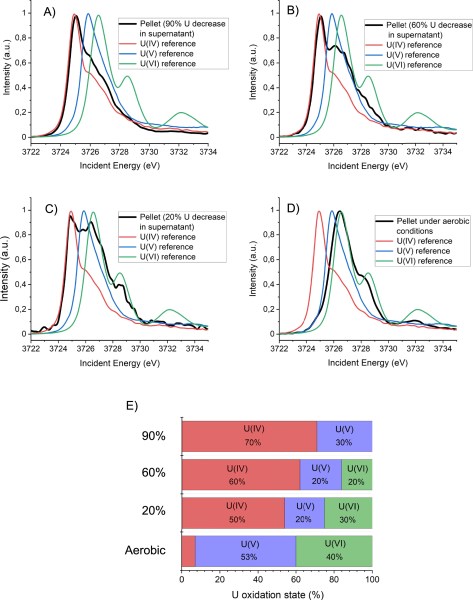
In addition to measuring how much contaminant disappeared, the team analysed what happened to the uranium during the process. Using geochemical analyses, advanced spectroscopic techniques and electron microscopy, the researchers identified reduced forms of uranium linked to the activity of the microorganisms. The analyses revealed an unusually high proportion of uranium in the +5 oxidation state, a rare chemical form and normally transient under environmental conditions.
«The results of our study were especially surprising, since, in the biomass analysed from our experiments, we found an unusually high proportion of uranium for the first time in the +5 oxidation state,» explains Antonio M. Newman-Portela, lead author of the study.
The results suggest that stimulating these microbial communities favours the uranium passing into less mobile and potentially more stable forms. Those forms of uranium in the +5 state remained even after several weeks of exposure to oxygen, which provides new data on how this element behaves under complex environmental conditions.
In the work, together with the UGR, researchers from the Helmholtz-Zentrum Dresden-Rossendorf (Germany), the European Synchrotron Radiation Facility in Grenoble (France) and the German company Wismut GmbH, which manages former uranium mining sites and supplied the water samples, have participated. The research is part of the international doctoral thesis of Newman-Portela, attached to the Doctoral Programme in Fundamental and Systems Biology of the UGR, and has been co-directed by Mohamed L. Merroun, professor of the Department of Microbiology of the UGR, together with Johannes Raff and Evelyn Krawczyk-Bärsch, from the German centre. Part of the analyses were done with the High-Resolution Transmission Electron Microscopy Unit of the UGR, directed by María del Mar Abad.
Share this story
Breaking news from News, on your phone
An alert only when something can't wait. Free, no account needed.
On iPhone, alerts only arrive if you first add GranadaYa to your Home Screen.
How to do it, step by step
This browser can't receive alerts. Try another one, such as Chrome or Safari.
You've blocked alerts from GranadaYa in this browser. You can turn them back on in its settings.
How to do it, step by step