A University of Granada study with DGT data follows 140 drivers who took point-recovery courses for three years.
GranadaYa newsroom
·
Photo: Universidad de Granada
Drivers who recover points after a sanction reoffend very frequently, but not all courses work the same. A team from the University of Granada (UGR) has followed for three years 140 drivers who had taken one of the three official courses required by the regulations: partial recovery of points, total recovery of the licence after losing all points, and courses ordered by a court.
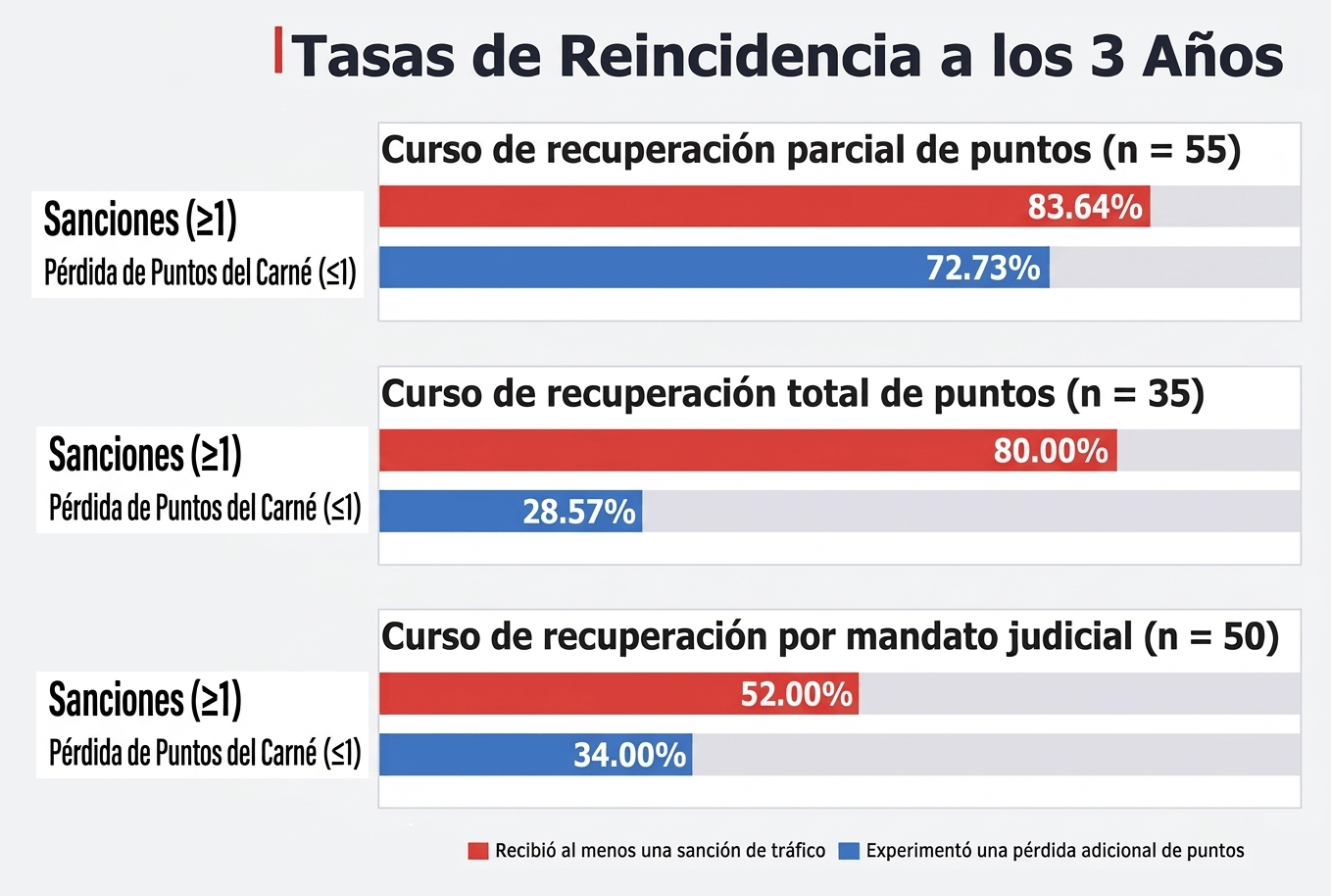
The overall result is that 71.4% of the participants committed at least one offence during the follow-up and 47.9% lost points again. The type of course makes the difference. Among those who took the partial recovery course, 83.6% were sanctioned again and 72.1% lost points again. In the total recovery course, 80% reoffended, although only 35% lost points, which points to less serious offences.
Court-ordered courses, the ones that work best
Participants in court-ordered courses respond best: 52% were sanctioned again and 34% lost points in the following three years. The researchers note that the type of course is the factor most associated with reoffending, above age, sex or substance use.
Professor Cándida Castro, from the UGR Department of Experimental Psychology, explains that the good results of court-ordered courses are due to the fact that they require "greater intervention, supervision and legal consequences, such as community service". By contrast, partial recovery courses "seem to have a lesser preventive effect, possibly because they are shorter and some drivers perceive them as an administrative procedure to recover points, rather than as a rehabilitation intervention".
The authors conclude that, twenty years after the introduction of the points-based licence, the results support the effectiveness of the system, but also the need to keep improving interventions aimed at those who reoffend. They advocate strengthening rehabilitation, supervision and follow-up of the courses so that they gain long-term effectiveness and help reduce accident rates.
The study has been published in the journal Accident Analysis & Prevention and uses official data from the Dirección General de Tráfico (DGT). It is signed by Cándida Castro, Francisca M. Padilla and Antonia P. Pacheco-Unguetti, from the Centro de Investigación Mente, Cerebro y Comportamiento (CIMCYC) of the UGR.
Share this story
Breaking news from News, on your phone
An alert only when something can't wait. Free, no account needed.
On iPhone, alerts only arrive if you first add GranadaYa to your Home Screen.
How to do it, step by step
This browser can't receive alerts. Try another one, such as Chrome or Safari.
You've blocked alerts from GranadaYa in this browser. You can turn them back on in its settings.
How to do it, step by step