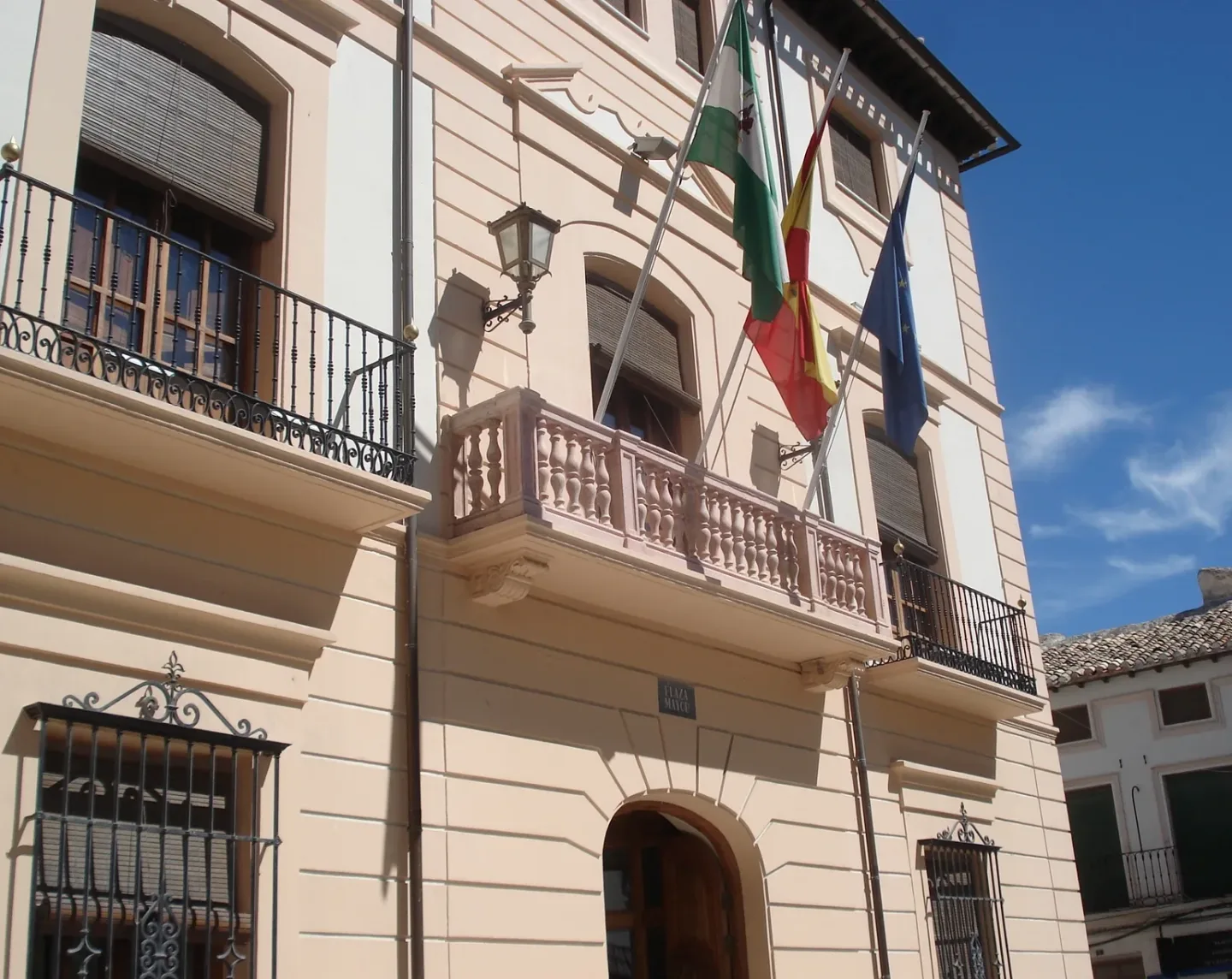
Huéscar published its declaration of war on Denmark in 1809 and never received official news of the 1814 peace. The oversight was closed on November 11, 1981 with a signing at its Town Hall. In a month it will be 45 years.
GranadaYa newsroom
·
Photo: Chorro / Wikimedia Commons (CC BY-SA 4.0)
On November 11, 1809, the council of Huéscar met to deal with ordinary matters. After two nights of frost, the grape growers were asking to begin the harvest, and the Town Hall set which days each one could pick their grapes. In that same session, something on another scale was reported: the declaration of war against Denmark.
The minutes, which are kept in the Municipal Historical Archive of Huéscar, record the agreement that "the Edict of Publication of the War against Denmark be posted." It was signed by the chief magistrate, Juan de Murcia y Montero, and the councilors present. From that paper comes the story of the town that spent 172 years at war with a Nordic country without firing a shot.
What the document says
The most complete study was published in 2010 by Juan Antonio Díaz Sánchez and Alfonso Miguel Torres Rosel in the Bulletin of the Pedro Suárez Center for Studies. They transcribe the minutes and explain the context.
In 1808 there were Spanish troops in Denmark in the service of Napoleon, under the command of the Marquis of la Romana. After the uprising against the French in Spain, most of those soldiers left the country with British help on August 20, 1808. Denmark remained on the side of France and, according to the study, handed over to the French some 3,500 Spanish soldiers it was holding prisoner.
The news of the rupture reached Huéscar through a dispatch signed in Seville on September 18, 1809, by the Marquis of Astorga. The newspaper El Debate, in a 2025 report, refers to a Royal Order.
The 2010 study presents it as a declaration of war by the city. A reading of the minutes allows for nuance: the council did not debate the war, but rather acknowledged the declaration and ordered it published, in the same session in which the grape harvest, an order on mare breeding and the sending of carts to Seville to supply the army were dealt with.
The peace between Spain and Denmark came in 1814, but, always according to Díaz Sánchez and Torres Rosel, Huéscar had no official news of it and its war edict remained unrevoked.
The discovery and the 1981 signing
The matter came to light thanks to the local archivist and researcher Vicente González Barberán. The 2010 study places the discovery "around the year 1980"; El Debate dates it to 1981.
On November 11, 1981, 172 years after the minutes, peace was signed at the Huéscar Town Hall. The website of the Danish Ministry of Foreign Affairs explains that Denmark and Spain signed a peace declaration that day at a ceremony in Huéscar. According to El Debate, the Danish ambassador, Mogens Wandel-Petersen, and the mayor, José Pablo Serrano, attended.
Díaz Sánchez and Torres Rosel add that the Foreign Ministry wanted to close the matter because Spain was preparing its entry into NATO. They do not cite any document to support this.
The Spanish Embassy in Copenhagen lists the twinning of Huéscar with Kolding as a consequence. The Danish city already appeared in this story: in March 1808 its castle burned while it was housing Spanish soldiers. According to the account reproduced in the 2010 study, the fire started because the soldiers, freezing, filled the chimneys with straw.
What is documented and what is colorful
The minutes of November 11, 1809, the peace between the two kingdoms in 1814, the signing of November 11, 1981 and the twinning with Kolding are documented.
The rest belongs to festive chronicle. El Debate recounts that six buses arrived with some 300 Danes, some dressed as Vikings, that residents brought two jars of wine out to the square and that there were lamb chops, morcilla and remojón. No source records combat or victims. What lasted 172 years was an unrevoked municipal edict, not a conflict.
Huéscar has made that anecdote a mark of identity. It presents itself as "City of Peace," according to the 2010 study. In 2025 it celebrated the 44th anniversary with events from November 8 to 12, including the screening of the documentary "La guerra más larga," by Jorge Rivera, according to an agency note published by Motor16. The story has also reached comics with "Hay que arreglar lo de Dinamarca."
Next November 11 will mark 45 years since that signing.
Share this story
Breaking news from News, on your phone
An alert only when something can't wait. Free, no account needed.
On iPhone, alerts only arrive if you first add GranadaYa to your Home Screen.
How to do it, step by step
This browser can't receive alerts. Try another one, such as Chrome or Safari.
You've blocked alerts from GranadaYa in this browser. You can turn them back on in its settings.
How to do it, step by step