Entrepreneurial intention among UGR students grows and exceeds the national average
Topics University of Granada
10.1% of UGR students want to start a business after finishing their studies and 17.9% within five years, compared with 8.2% and 17% in 2023.
GranadaYa newsroom ·
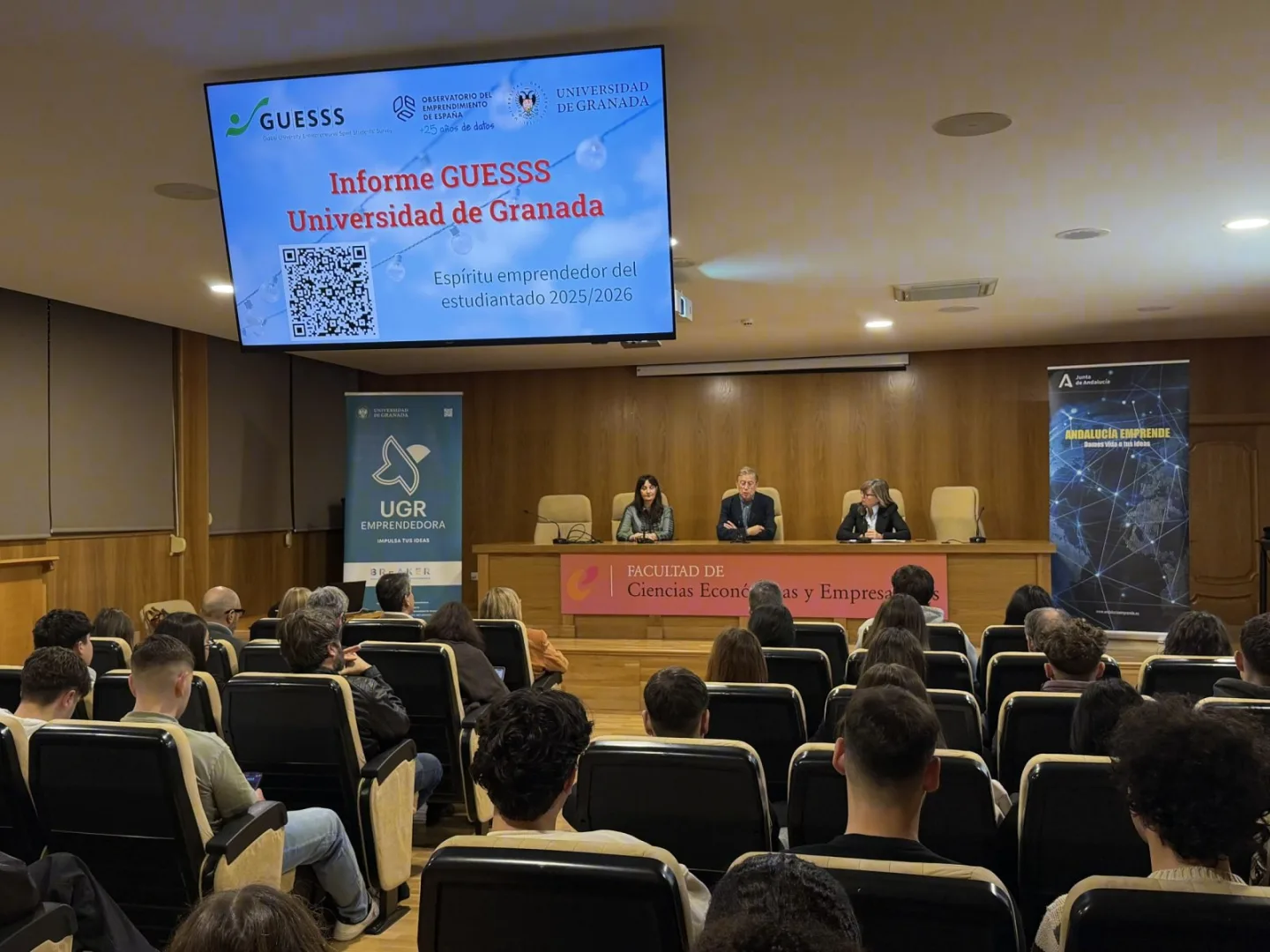
Entrepreneurship is gaining ground among those studying at the University of Granada (UGR). 10.1% of students intend to start a business after finishing their studies and 17.9% are considering it within five years, compared to 8.2% and 17% in 2023. Across Spain both percentages fall slightly, according to the GUESSS 2025/2026 Report presented by the UGR based on 1,244 responses.
The preference for entrepreneurship after finishing the degree has doubled since 2014, when it was 4.9%. Even so, public employment remains the preferred path: 27.9% choose it after finishing their studies and 29.2% within five years. It is followed by large companies (13.9%) and academic institutions (13.5%).
By field, administration and business (19.3%), economics (14.9%) and engineering (13.2%) lead the intention to start a business after finishing. Within five years, computer science (29%), economics (28.4%) and administration and business (26.4%) stand out.
Less gap between men and women
Men remain ahead in intention to start a business, but the difference within five years is 2.2 points (19.3% versus 17.1%), well below the 9.1 points for Spain as a whole. In nascent entrepreneurship, by contrast, men double women (11.8% versus 5.2%).
7.6% of students are taking steps to create a company and 1.8% already have one underway. The decline compared to 2023 follows the national and international trend and, according to the UGR, should be read with caution because the 2025 edition uses a more restrictive definition of these variables. Solo projects fall from 64.2% to 55.9%, and eight in ten expect to complete them during their studies or right after finishing them.
The white economy (health) is the preferred sector for a professional career (26.2%), above Spain and the global average, and the social and solidarity economy also exceeds those references (16.6%).
More training and better assessment of the entrepreneurial climate
The proportion of students who have never taken an entrepreneurship course falls from 70.2% to 67.9%, somewhat below the Spanish average (68.1%). Among those creating a business, that proportion drops to 42.6%. Voluntary training is the most common: 23.7% have taken at least one course of this type, and 13% have taken compulsory training within their curriculum (10.3% in Spain).
The assessment of the UGR's entrepreneurial climate improves for the second consecutive edition and reaches 3.8 out of 7, and 4.4 among those creating a business. The best rated aspects are motivation to take part in entrepreneurial activities (4.1) and access to advice and guidance (4.0).
The report was prepared by professors María del Mar Fuentes Fuentes and María José González López and professor Sufia Mohand-Amar, of the UGR, within the international project Global University Entrepreneurial Spirit Students' Survey (GUESSS), coordinated in Spain by the Observatorio del Emprendimiento de España. The 2025 edition involved more than 196,000 students from 66 countries, 48,462 of them from 71 Spanish universities. The presentation event was held on Tuesday, November 24 in the Aula Magna of the Facultad de Ciencias Económicas y Empresariales, at the Jornada de Emprendimiento de UGR Emprendedora, of the Vicerrectorado de Innovación Social, Empleabilidad y Emprendimiento, with the collaboration of Andalucía Emprende.
Breaking news from News, on your phone
An alert only when something can't wait. Free, no account needed.
On iPhone, alerts only arrive if you first add GranadaYa to your Home Screen. How to do it, step by step
This browser can't receive alerts. Try another one, such as Chrome or Safari.
You've blocked alerts from GranadaYa in this browser. You can turn them back on in its settings. How to do it, step by step
Only what can't wait. Change or remove it in my alerts
Shall we let you know what matters?
Phone alerts
On iPhone, alerts only arrive if you first add GranadaYa to your Home Screen. How to do it, step by step
This browser can't receive alerts. Try another one, such as Chrome or Safari.
You've blocked alerts from GranadaYa in this browser. You can turn them back on in its settings. How to do it, step by step