
The Planetary Health exhibition can now be visited online with contributions from the UGR
Topics University of Granada
The virtual tour of the international exhibition from the Deutsches Museum in Munich includes the participation of professor José María Martín Civantos, director of the MEMOLab laboratory at the University of Granada.
GranadaYa newsroom ·
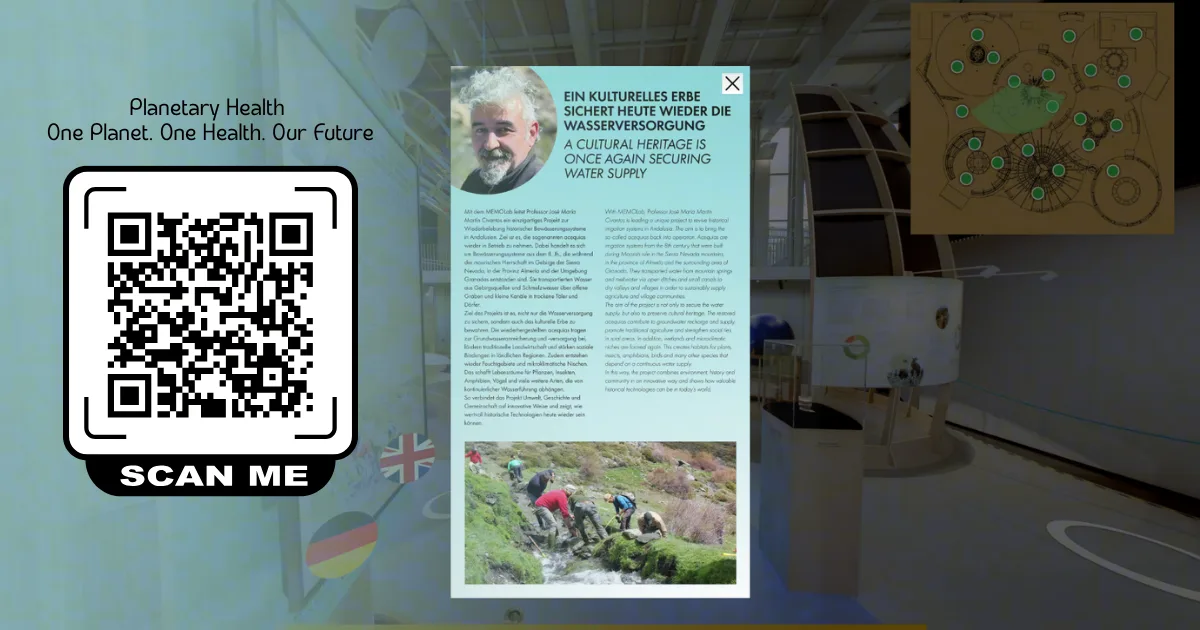
The international exhibition Planetary Health – One Planet. One Health. Our Future, organized at the Deutsches Museum in Munich, can be visited from anywhere through a virtual tour. Access is available at the virtual tour of the exhibition.
What can be seen
The exhibition addresses the concept of planetary health, an approach that links human well-being with the state of natural systems. From an interdisciplinary perspective, it invites reflection on environmental challenges and the interactions between human societies and their environment.
Among the contributions present is that of professor José María Martín Civantos, from the Department of Medieval History and Historiographic Sciences and Techniques of the Universidad de Granada and director of MEMOLab – Biocultural Archaeology Laboratory. According to the Universidad de Granada, his participation represents international recognition of a line of research that connects historical and archaeological knowledge with debates on sustainability, resource management and landscape transformation.
Biocultural archaeology
The work of MEMOLab-UGR starts from the premise that current landscapes are the result of a long interaction between natural processes and the societies that have inhabited them. The study of historical irrigation systems, traditional water management practices, local ecological knowledge and community forms of organization allows us to understand how communities have used and cared for their territories over time.
This perspective, notes the academic institution, helps to overcome a vision that separates nature from culture and recognizes that biodiversity, heritage and traditional knowledge are part of interdependent systems. It also allows exploring the possibilities offered by historical experiences to address problems such as climate change, environmental degradation, biodiversity loss and the sustainable management of natural resources.
Free access
The virtual tour broadens access to the exhibition and makes it easier for anyone interested to learn about its contents. No prior registration is required: simply enter the indicated address.
Breaking news from News, on your phone
An alert only when something can't wait. Free, no account needed.
On iPhone, alerts only arrive if you first add GranadaYa to your Home Screen. How to do it, step by step
This browser can't receive alerts. Try another one, such as Chrome or Safari.
You've blocked alerts from GranadaYa in this browser. You can turn them back on in its settings. How to do it, step by step
Only what can't wait. Change or remove it in my alerts
Shall we let you know what matters?
Phone alerts
On iPhone, alerts only arrive if you first add GranadaYa to your Home Screen. How to do it, step by step
This browser can't receive alerts. Try another one, such as Chrome or Safari.
You've blocked alerts from GranadaYa in this browser. You can turn them back on in its settings. How to do it, step by step