
The UGR joins the four innovation laboratories of the UN scientific network
Topics Diputación de Granada Granada 2031 University of Granada
The 2026 report of the Knowledge and Scientific Network of the United Nations Local2030 Coalition includes the University of Granada among its four Innovation Laboratories and highlights the Impronta model, which connects research with institutions and the priorities of the territory.
GranadaYa newsroom ·
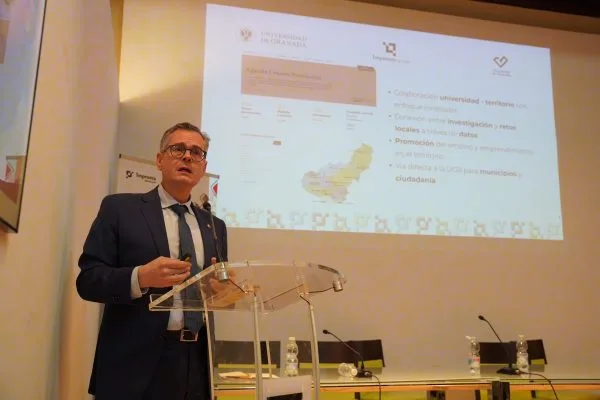
The University of Granada (UGR) is among the four Innovation Laboratories (InnoLabs) of the Knowledge and Scientific Network of the United Nations Local2030 Coalition, according to the University itself. The network brings together academic institutions recognized for their capacity to transform research into solutions for territorial development.
What Impronta is
The report devotes two pages to the UGR and highlights the Impronta model as an example of collaboration between university and territory. This approach starts from concrete challenges and connects the needs of public administrations with the scientific and technical capacities of the University.
Impronta Granada was launched at the end of 2022 as an alliance between the UGR and the Diputación de Granada. It has produced initiatives such as the UGR District Councils, the Public Innovation Laboratories, citizen science and the Impronta Granada Awards. The report also cites Granada Tierra Viva, within the European project SOILCRATES, which addresses soil degradation, water scarcity and climate resilience with producers, administrations and the scientific community.
From the provincial scope to the Andalusian one
The provincial experience has been extended with Impronta Andalucía, promoted in 2025 together with the Instituto Andaluz de Administración Pública (IAAP). It integrates the regional administration, the diputaciones, the municipalities, Ceuta and Melilla and, progressively, the Andalusian public universities.
In March 2026 a first meeting brought together some 150 people from the scientific, institutional and third-sector spheres to identify shared priorities. In June progress was made on cultural policies in Andalusia, also in support of Granada 2031's bid to be European Capital of Culture.
The UGR shares the recognition with the University of South Africa, Cagayan State University (Philippines) and Utah Valley University (United States). The network is promoted by the Government of Italy together with UN-Habitat and the Centro Studi di Politica Internazionale (CeSPI), and is part of the Local2030 Coalition, the United Nations platform for the localization of the 2030 Agenda.
Iñigo Arbiol, deputy director of the Secretariat of the United Nations Local2030 Coalition, states that the UGR's experience as an InnoLab is "an example of how to move from research to action" and that connecting scientific knowledge with the priorities of territories is essential to close the implementation gaps of the Sustainable Development Goals.
The full report, "2026 KSN Report: Enhancing the Role of Academia in SDG Localization", is available for download. The contact for inquiries is the Vice-Rector for Social Innovation, Employability and Entrepreneurship, Esteban Romero Frías (viceinnova@ugr.es).
Breaking news from News, on your phone
An alert only when something can't wait. Free, no account needed.
On iPhone, alerts only arrive if you first add GranadaYa to your Home Screen. How to do it, step by step
This browser can't receive alerts. Try another one, such as Chrome or Safari.
You've blocked alerts from GranadaYa in this browser. You can turn them back on in its settings. How to do it, step by step
Only what can't wait. Change or remove it in my alerts
Shall we let you know what matters?
Phone alerts
On iPhone, alerts only arrive if you first add GranadaYa to your Home Screen. How to do it, step by step
This browser can't receive alerts. Try another one, such as Chrome or Safari.
You've blocked alerts from GranadaYa in this browser. You can turn them back on in its settings. How to do it, step by step