
The UGR obtains fatty acids from alperujo with electric current
Topics University of Granada
Researchers from the University of Granada and the Instituto de la Grasa de Sevilla validate an electrodialysis system that recovers 55% of the volatile fatty acids from alperujo, the residue of oil production.
GranadaYa newsroom ·
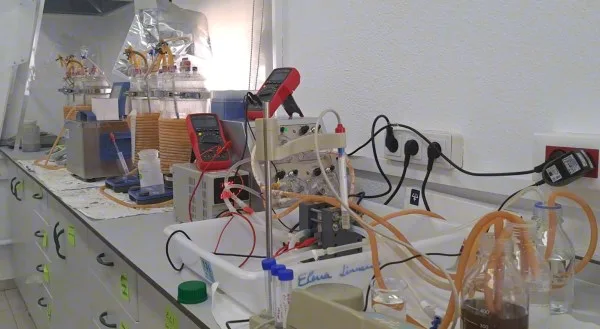
Alperujo, the residue left after olive oil production, may stop being a problem for olive mills. A team from the University of Granada (UGR) and the Instituto de la Grasa de Sevilla (IG-CSIC) has managed to extract volatile fatty acids from it by applying electric current, according to UGR.
What is achieved
The technique, called electrodialysis, works as a selective filter driven by electric current to separate and concentrate molecules of interest in a liquid mixture. Applied to a real alperujo fermentate, it recovered 55 % of the volatile fatty acids, compared with 60 % obtained with a solution prepared in the laboratory. The system reached an electrical efficiency of 86 %.
These compounds serve as raw material to manufacture bioplastics, cosmetics, hygiene or cleaning products. Among them is acetic acid, the main component of vinegar, which in this case is not intended for human consumption but for industrial uses.
Why it matters
Until now electrodialysis had only been tested with much simpler laboratory solutions. The novelty is that it works directly on the real fermentate, despite its complexity: almost half of the matter resulting from fermentation is unidentified, which makes it difficult to isolate only the useful compounds.
Compared with traditional methods such as distillation, which separates molecules with heat, or resins, which need chemicals to release what has been captured, electrodialysis uses only electric current. According to UGR researcher Elena Jiménez, lead author of the study, this "can reduce energy consumption, simplify the process and facilitate industrial scaling".
Towards the biorefinery
The researchers propose integrating the technology into the fermentation process itself, removing the compounds as they are generated to prevent them from accumulating and slowing the activity of the microorganisms. The project lead, Antonio Serrano, notes that this way olive mills could turn alperujo into a product with economic value instead of managing it as waste.
The study has been published in the journal ACS Sustainable Chemistry & Engineering and has received funding from the Consejería de Universidad, Industria, Energía e Innovación de la Junta de Andalucía, through the EMERGIA projects. The Instituto IMDEA de Alcalá de Henares has also participated in it.
Breaking news from News, on your phone
An alert only when something can't wait. Free, no account needed.
On iPhone, alerts only arrive if you first add GranadaYa to your Home Screen. How to do it, step by step
This browser can't receive alerts. Try another one, such as Chrome or Safari.
You've blocked alerts from GranadaYa in this browser. You can turn them back on in its settings. How to do it, step by step
Only what can't wait. Change or remove it in my alerts
Shall we let you know what matters?
Phone alerts
On iPhone, alerts only arrive if you first add GranadaYa to your Home Screen. How to do it, step by step
This browser can't receive alerts. Try another one, such as Chrome or Safari.
You've blocked alerts from GranadaYa in this browser. You can turn them back on in its settings. How to do it, step by step