Losing weight reduces liver fat more than fasting schedule
Topics Hospital Universitario Virgen de las Nieves University of Granada
A trial with 197 participants from Granada and Navarra concludes that losing at least 5% of body weight is what truly improves the liver, whenever you eat.
GranadaYa newsroom ·
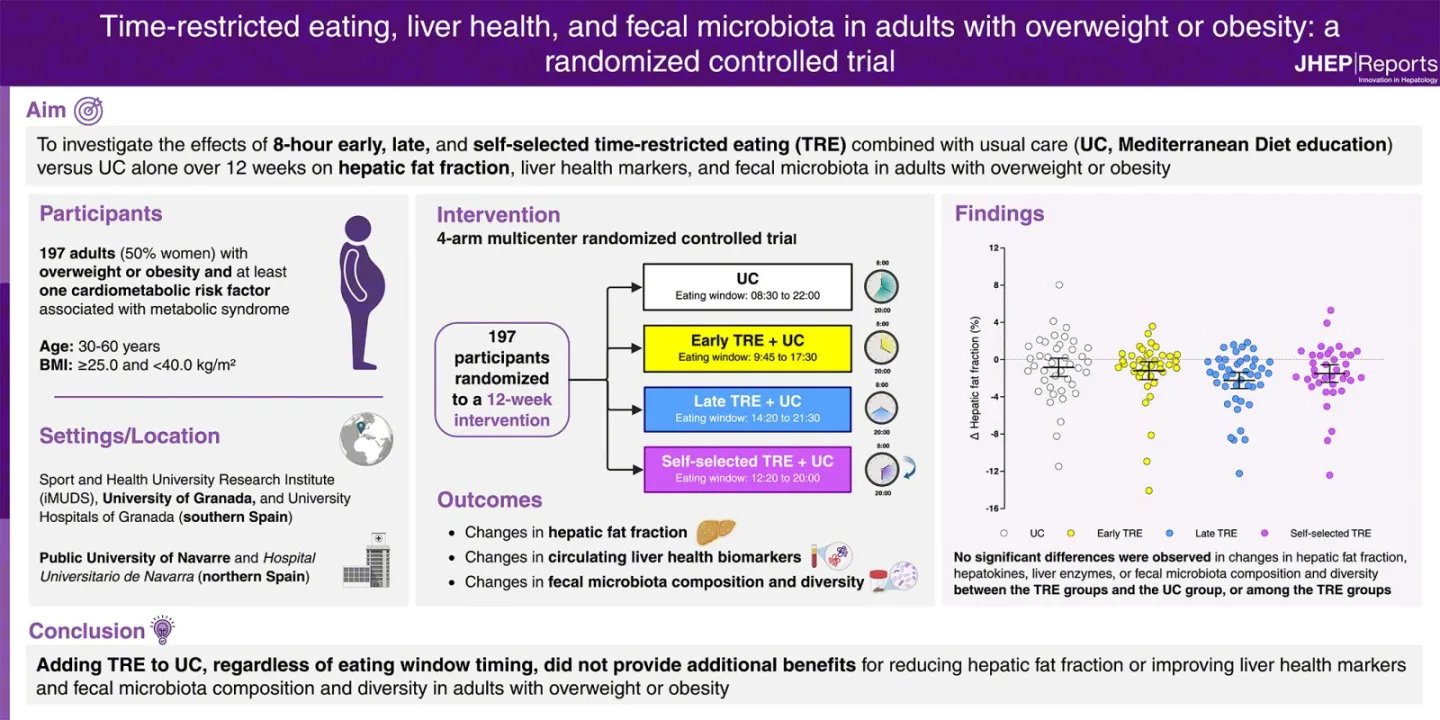
The study followed 197 people aged between 30 and 60 with overweight or obesity for 12 weeks. All received the same nutritional education program based on the Mediterranean diet and healthy habits. In addition, they were randomly divided into four groups: one followed only that usual treatment and the other three added a fasting window. One group ate approximately between 9 and 17 hours; another, between 14 and 22; and a third freely chose their schedule, on average between 12:20 and 20 hours.
Liver fat was measured with magnetic resonance imaging. Although it decreased in the three groups that fasted, the differences compared with the group that only followed the diet were not statistically significant. Nor were there differences between fasting in the morning, in the afternoon or at whatever time each person chose, nor in other liver health indicators or in the fecal microbiota.
The 5% threshold
Where a clear difference did appear was in those who lost weight. Between 40 and 45% of the people who did intermittent fasting lost at least 5% of their weight, and reaching that threshold was associated with a significantly greater reduction in liver fat. The improvements were especially visible among those who already had hepatic steatosis at the start of the study.
This work is a secondary analysis of a previous trial published in Nature Medicine. That one showed that those who did intermittent fasting, whatever their schedule, lost on average between three and four kilos more than the group that only received nutritional recommendations, and that early fasting showed benefits on some glucose regulation indicators.
The study is part of the doctoral thesis of Antonio Clavero Jimeno, a predoctoral researcher at the Instituto Mixto Universitario Deporte y Salud (iMUDS) of the UGR, and he has led it together with Manuel Dote Montero. It is headed by the PROFITH CTS-977 group of the iMUDS, directed by professor Jonatan Ruiz Ruiz, in collaboration with ibs.GRANADA, the Hospital Universitario Clínico San Cecilio, the Hospital Universitario Virgen de las Nieves and the Universidad Pública de Navarra, according to the UGR.
Breaking news from News, on your phone
An alert only when something can't wait. Free, no account needed.
On iPhone, alerts only arrive if you first add GranadaYa to your Home Screen. How to do it, step by step
This browser can't receive alerts. Try another one, such as Chrome or Safari.
You've blocked alerts from GranadaYa in this browser. You can turn them back on in its settings. How to do it, step by step
Only what can't wait. Change or remove it in my alerts
Shall we let you know what matters?
Phone alerts
On iPhone, alerts only arrive if you first add GranadaYa to your Home Screen. How to do it, step by step
This browser can't receive alerts. Try another one, such as Chrome or Safari.
You've blocked alerts from GranadaYa in this browser. You can turn them back on in its settings. How to do it, step by step